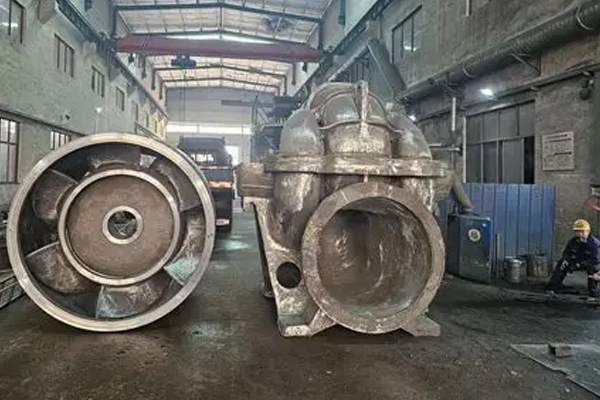
Foundy Chromite Sand for Large heavy hydroelectric Ball Valve Gate
Large heavy hydroelectric ball valve gate castings are crucial components of large generator sets. These castings can weigh up to 100 tons, with a wall thickness difference of more than four times between their maximum and minimum thickness points. This generates significant stress during solidification, making them prone to hot cracking, shrinkage cavities, and sand adhesion. In such large castings, using foundry chromite sand as the core sand for alkali-phenolic resin instead of quartz sand effectively prevents sand adhesion defects and facilitates sequential solidification during casting.
Foundry chromite sand offers the following advantages in casting large-tonnage hydroelectric generator ball valves/gates:
1. Strong resistance to sand adhesion and metal penetration.
Hydroelectric valves are large-tonnage, thick-walled cast steel parts with high molten steel temperatures, high static pressures, and prolonged heating time. Foundry Chromite Sand obtain high refractoriness and stable chemical properties effectively resist molten steel penetration and sintering sand adhesion, resulting in a smooth inner surface of the casting and significantly reducing subsequent grinding and cleaning work. Quartz sand, on the other hand, is highly susceptible to severe sand adhesion and penetration defects under these conditions.
2. Extremely Low Thermal Expansion Rate, Preventing Core Cracking and Casting Veins.
Quartz sand expands significantly at high temperatures, making large cores prone to cracking and deformation upon heating, leading to veins, flash, and dimensional deviations in the casting. Chromite sand has an extremely low coefficient of thermal expansion, ensuring core volume stability at high temperatures and guaranteeing the integrity of cores in complex internal cavities, thus ensuring the dimensional accuracy of the valve casting.
3. Excellent Chilling Effect, Reducing Internal Casting Defects.
Chromite sand has a much higher thermal conductivity than quartz sand, accelerating the directional solidification of molten metal in thick-walled areas. This effectively reduces defects such as shrinkage cavities, porosity, and hot cracks, resulting in a dense and uniform internal structure that meets the high pressure and high reliability requirements of hydraulic valves.
4. Excellent compatibility with alkali-phenolic resin, resulting in stable sand core performance.
Chromite sand has mild surface properties and excellent compatibility with alkali-phenolic resin binders. The resulting sand cores meet standards for room temperature strength, high temperature strength, and collapse resistance, have a long shelf life, and exhibit stable molding and core-making processes during mass production, avoiding issues such as resin failure and sand core softening.
5. Strong high-temperature thermal stability, suitable for long-term casting processes.
Large castings involve long casting processes, during which sand cores are exposed to high-temperature radiation environments for extended periods. Chromite sand is heat-resistant and does not easily soften or collapse, allowing large, integral sand cores to maintain their original shape, preventing internal cavity deformation and uneven wall thickness, and ensuring the valve’s internal structure meets design requirements.
6. Better reusability and lower overall production costs.
Chromite sand is heat-resistant and has high mechanical strength, resulting in a higher recycling rate than quartz sand. Although the purchase price is higher, the scrap rate and rework volume of castings are significantly reduced, sand consumption is decreased, and the overall production cost is more favorable.
7. Enhanced operational safety.
Chromite has an extremely low free silica content, which significantly reduces the risk of silicosis for frontline operators compared to quartz sand, thus improving the workshop working environment.