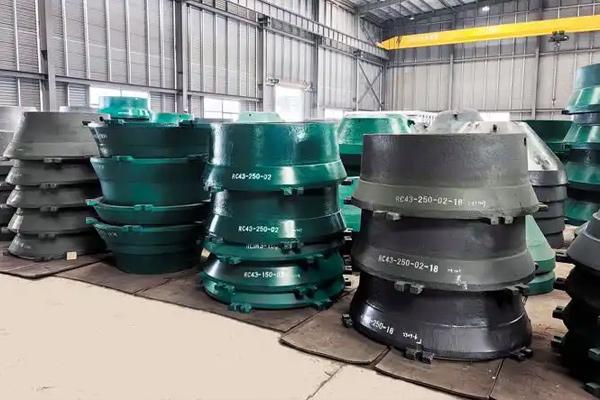
AFS45-50 chromite sand for casting of high-manganese steel cone crusher jaw liners
AFS45-50 chromite sand has unique advantages as both face sand and molding sand in the casting of high-manganese steel (Mn18Cr2/Mn22Cr2) liners for cone crusher jaws.
Cone crusher jaw liners are generally made of high-manganese steel. The main components of high-manganese steel include carbon (C), manganese (Mn), and chromium (Cr). This composition allows the surface of high-manganese steel to work harden under strong impact, further improving its wear resistance. High-manganese steel castings can maintain stable performance under various harsh working conditions, extending the service life of the equipment. Commonly selected raw materials include ZGMn13, ZGMn13Cr2, ZGMn18, ZGMn18Cr2, and ZGMn21Cr2. High-quality wear-resistant liners place high demands on castings. Castings produced must be free of cracks and casting defects that affect performance, such as inclusions, sand inclusions, cold shuts, porosity, shrinkage cavities, and insufficient filler. Cone crusher liners are large, thick-walled castings, and preventing casting defects is crucial for improving yield and casting quality. South African chromite sand with a Cr₂O₃ content of ≥46% is an important component in achieving this goal. Its advantages are as follows:
1. Rapid Cooling Effect
Chromite sand with Cr₂O₃ ≥46% has a thermal conductivity 2-3 times higher than silica sand. Its AFS45-50 particle size (≈0.3 mm) maximizes the specific surface area, resulting in an initial cooling rate of 700-900 ℃/s upon contact with molten steel. This allows for the instantaneous formation of a 3-8 mm thick fine-grained layer on the surface of the high-manganese steel (grain size can be refined to ASTM 5-6 grade), which is beneficial for the sequential solidification of the casting and reduces porosity defects.
2. Solid-Solid Phase Transformation Buffer
High-manganese steel does not undergo solid-state phase transformation, but it has a large shrinkage rate (linear shrinkage 2.9–3.4%). Chromite sand has a thermal expansion coefficient of only 5 × 10⁻⁶/℃ (silica sand is 12 × 10⁻⁶/℃), and a narrow particle size distribution. At high temperatures, the sand shell does not bulge or crack, allowing for stable control of the outer contour dimensional tolerance of the liner plate within ±0.5 mm, reducing secondary machining.
3. Chemically Inert Anti-Adhesion Sand
Cr₂O₃ is a neutral oxide and does not form low-melting-point compounds with MnO and FeO at 1600℃; however, silica sand easily reacts with Mn at this temperature to form MnO·SiO₂ (melting point 1250℃), causing chemical adhesion. Using chromite sand as a surface sand can reduce the adhesion defect rate from 5% to <0.3%, shortening cleaning time by 70%.
4. Anti-wetting barrier
Chromite sand has a melting point >1800℃, far exceeding the casting temperature of high-manganese steel (1450~1480℃), making it difficult for molten steel to wet the sand particles. Simultaneously, Cr₂O₃ undergoes trace reduction at high temperatures to form a dense FeCr₂O₄ spinel layer, further preventing metal penetration and improving surface roughness.
5. Recycling performance
After repeated thermal cycling at 1400℃, the angularity coefficient of chromite sand increases by only 5%, and the breakage rate is <0.2%, allowing for multiple reuses. In contrast, silica sand undergoes phase transformation expansion and pulverization after a single high-temperature treatment, with a recovery rate below 60%. Long-term production can reduce molding material costs by 15-20%.
In summary, in the casting of high manganese steel liners for cone crusher grinding chambers, AFS45-50 chromite sand is not simply “refractory sand.” Instead, it employs a triple mechanism of “high thermal conductivity quenching + low expansion shape preservation + chemical inertness to prevent sticking” to impart high hardness, high density, and defect-free as-cast quality to the liner surface in one go, thereby improving the quality of the casting and significantly reducing post-cleaning and machining costs.